
Identifying Hickory Nuts: What to Observe and When to Ask an Expert
Identifying a hickory nut begins with the tree, not a taste test. Leaves, buds, bark, fruit and location all provide evidence. A loose brown nut or one photograph rarely supplies enough information to establish both its identity and suitability for food.
This guide explains what to observe in North American hickories. It is not a complete botanical key, and a photo guide alone cannot establish edible identification. Ask a knowledgeable local botanist, extension specialist or experienced foraging instructor to verify an unfamiliar tree and its fruit before eating anything from it.
Record the whole tree and the fruit together
Keep a note of where and when you found the tree. Photograph the entire tree, bark, a leafy twig, buds and fruit with its outer covering intact. Include a ruler for scale when practical. Do not assume every nut on the ground came from the tree directly above it.
The Missouri Department of Conservation's field guide describes hickory leaves as compound and shows how bark, buds and fruit vary across species. Photograph a complete leaf with all its leaflets attached; this makes its structure clearer to someone reviewing your find.
Separate the husk from the nutshell
The husk is the fruit's outer covering. The hard nutshell is underneath, enclosing the kernel. Note the intact husk, its thickness and the way it opens, rather than photographing only the bare nut.
For example, the Minnesota Department of Natural Resources describes shagbark fruit as having an outer husk that divides into four sections at maturity. That is a useful observation, but it is not sufficient on its own to establish a species or edible identity.
Use distinctive features as clues, not shortcuts
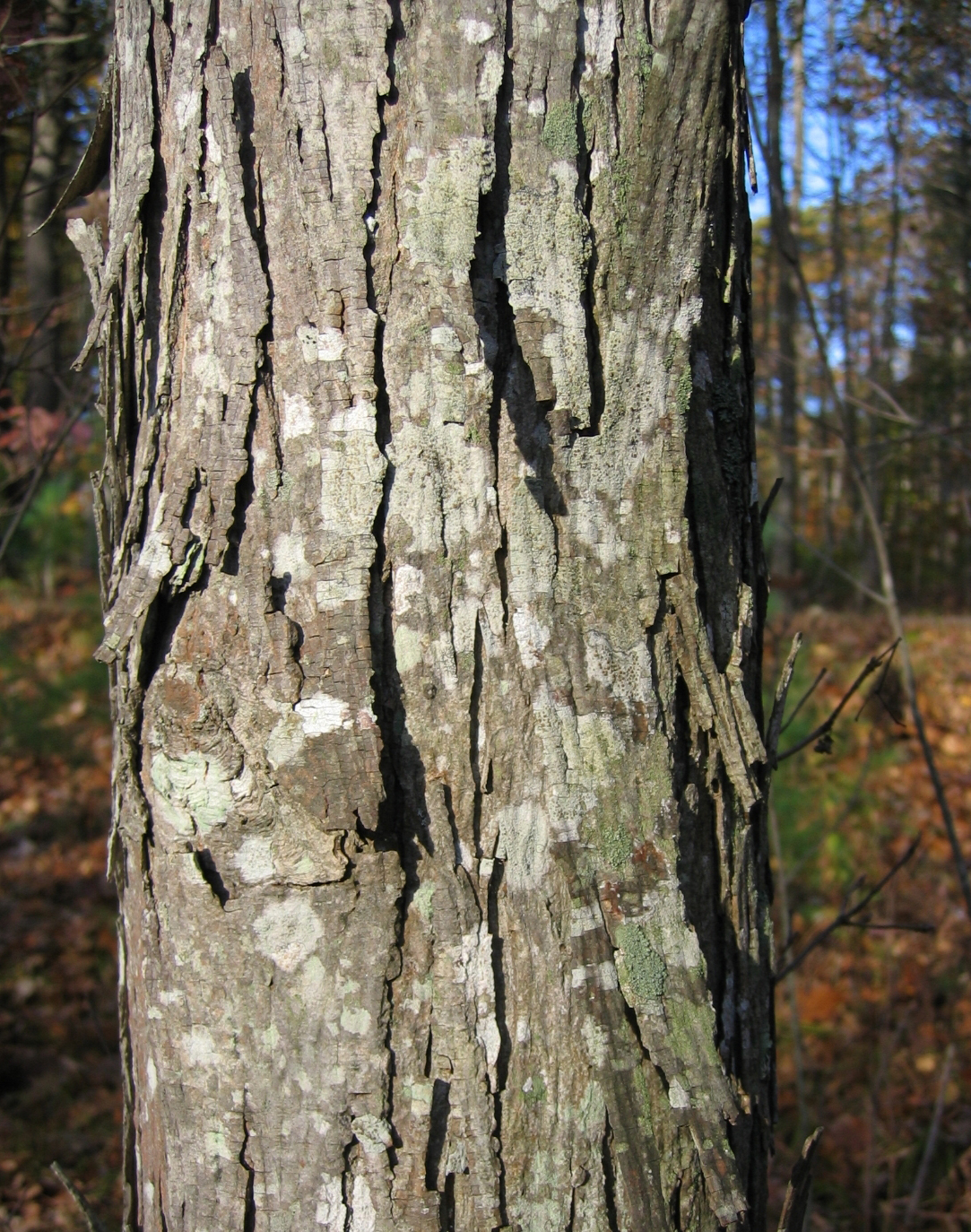
Peeling bark
Older shagbark hickories develop conspicuous strips of bark. NC State Extension's shagbark profile includes photographs of the bark, leaves, buds and fruit. A young tree may look different from the mature trunk in a reference picture.

Yellow buds
Long yellow buds are an important feature of bitternut hickory in NC State Extension's species profile. The name refers to its bitter nuts. Use visible botanical features, never a taste test, to investigate an unfamiliar specimen.
Nut size and shape
Record both length and width, together with the shape and condition of the husk. An expert can use these measurements alongside the leaves, buds and regional distribution to compare possibilities.
Why lookalike rules can be dangerous
A husk around a seed does not prove that it is a hickory. Neither does a pale patch, a brown surface or the appearance of the inside after cracking. Do not rely on a “solid versus divided kernel” rule to rule out poisonous seeds.
Poison Control identifies horse chestnuts as toxic and warns against eating unfamiliar seeds. Wildlife eating a seed also does not establish that it is suitable for people. If someone has eaten an unidentified seed, contact the appropriate poison information service or medical service for their location rather than waiting for an online identification.
Identification is only the first step toward food
A correctly named edible species still needs sound harvesting, handling and storage. Obtain permission to collect, follow local rules and ask for species-specific preparation advice. Do not mix uncertain nuts into a known batch.
For food-grade, ready-to-eat nuts, use a suitable nutcracker and inspect the kernels for shell fragments before serving. Read our kitchen guide for ingredient choices and uses. For a broader species overview, see our guide to hickory nuts.