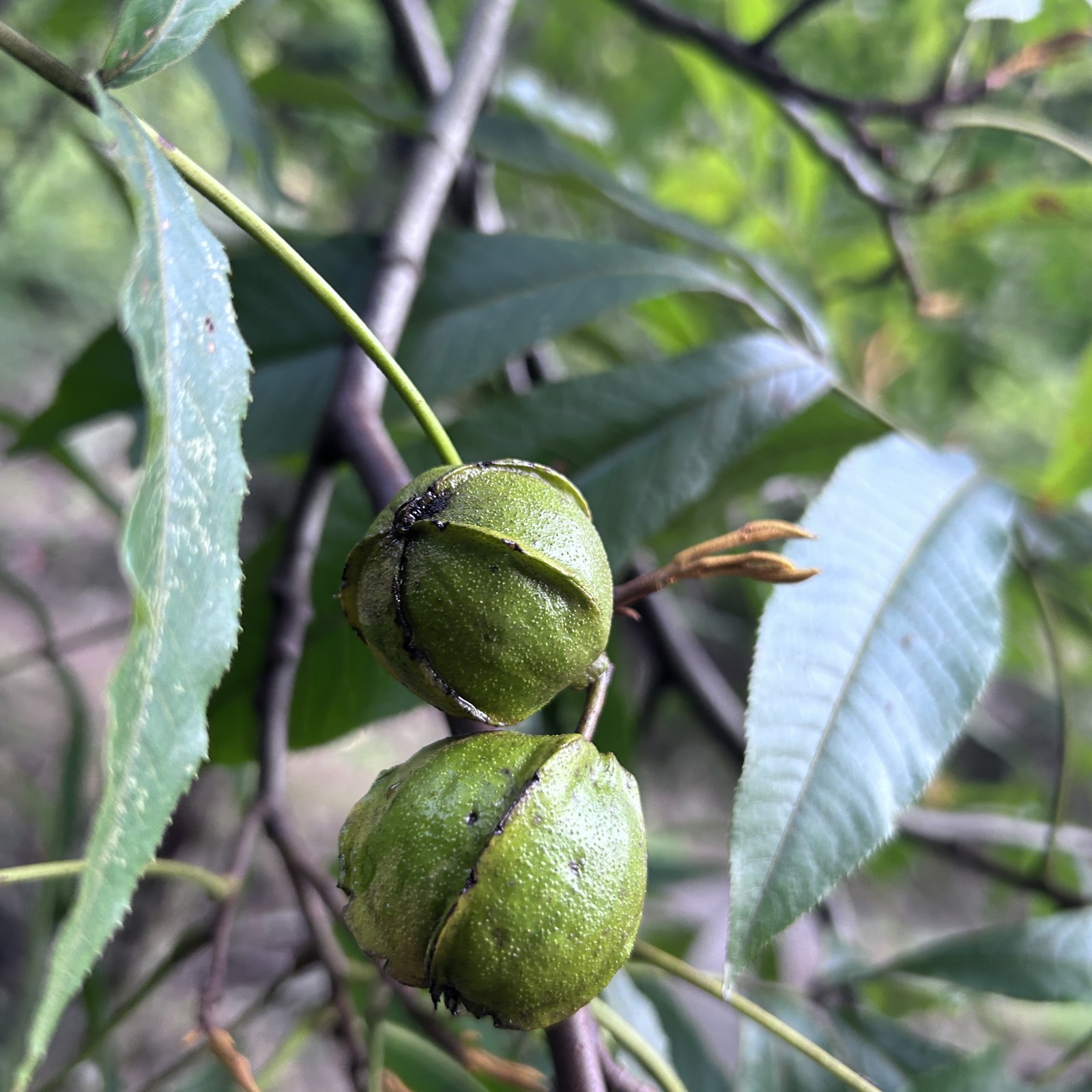
Chinese hickory fruits in their green outer husks, photographed in a Lin’an orchard. Photo: Na Jia, Chengjin Fu, Kai Chen and Jiuqing Liu / CaryaData / CC BY 4.0. Resized for web.
When Are Lin’an Hickory Nuts Harvested? Season and Processing
Updated 2 November 2026
A bag of Chinese hickory kernels is several steps removed from the fruit collected in Lin’an’s hills. Harvesting is only the beginning: the outer husk must come off, unsuitable nuts must be removed, and the crop must be prepared for the product being sold. Nuts left in their shells take a different route from ready-to-eat kernels.
Those stages help explain what work goes into a finished product. They do not supply a universal price formula. This account draws on published regional reporting, processing guidance and research, rather than our own farm visits or interviews.
When does Lin’an’s hickory harvest begin?
The local opening date is announced for each harvest. In 2026, Lin’an’s season formally began on September 7, according to a September 8 Zhejiang Daily report. Check the announcement for the year concerned rather than treating one date as permanent.
The report described grower Wang Liping using new equipment at his plantation, including a trunk-mounted vibrating harvester. Officials said that machine was still being trialled and promoted. Elsewhere, drones carried harvested fruit downhill and monorail transport connected hillside collection with vehicles below. This is not an industry in which every movement of every nut is necessarily done by hand.
Labour nevertheless matters. The same report put skilled harvesters’ daily pay at 500 yuan, sometimes reaching 800 yuan. These are reported local day rates in September 2026, not a labour charge per kilogram of kernels. They cannot be converted into one without knowing each crew’s output and working conditions.
First remove the husk, not the edible kernel
It helps to keep three parts separate: the outer fruit covering, the hard shell beneath it, and the kernel inside. Removing the husk leaves an in-shell nut. It does not produce a bowl of ready-to-eat kernels.
Zhejiang’s March 2022 vocational competency specification for Lin’an hickory processing makes that early work explicit. It covers operating husking machinery, washing and removing floating empty nuts, drying, storage, and equipment for grading and flotation sorting.
This is a skills specification, not proof that every business uses an identical production line. Its value is in showing that the raw-material stage already involves several separate operations before the snack-making work begins.
Sorting decides which nuts move forward
A producer example makes the selection work more concrete. In a September 2025 Daily Business report and sales feature, He Liye, who runs the Shanmeizi brand in Yinkeng village, described flotation sorting followed by size grading. The report listed diameter grades of 2.15, 2.0 and 1.95 centimetres.
It also described boiling, cracking, seasoning and roasting, followed by another manual selection. Machines were operating in the workshop too. The useful distinction is between the jobs: equipment can handle repeated processing while people still inspect the result. This one producer’s method should not be turned into a claim that all Chinese hickory is handmade.
Two routes: prepared shells or separated kernels
The China National Intellectual Property Administration’s published Lin’an geographical-indication requirements set out separate pathways for prepared nuts and kernels (printed pages 1324–1326).
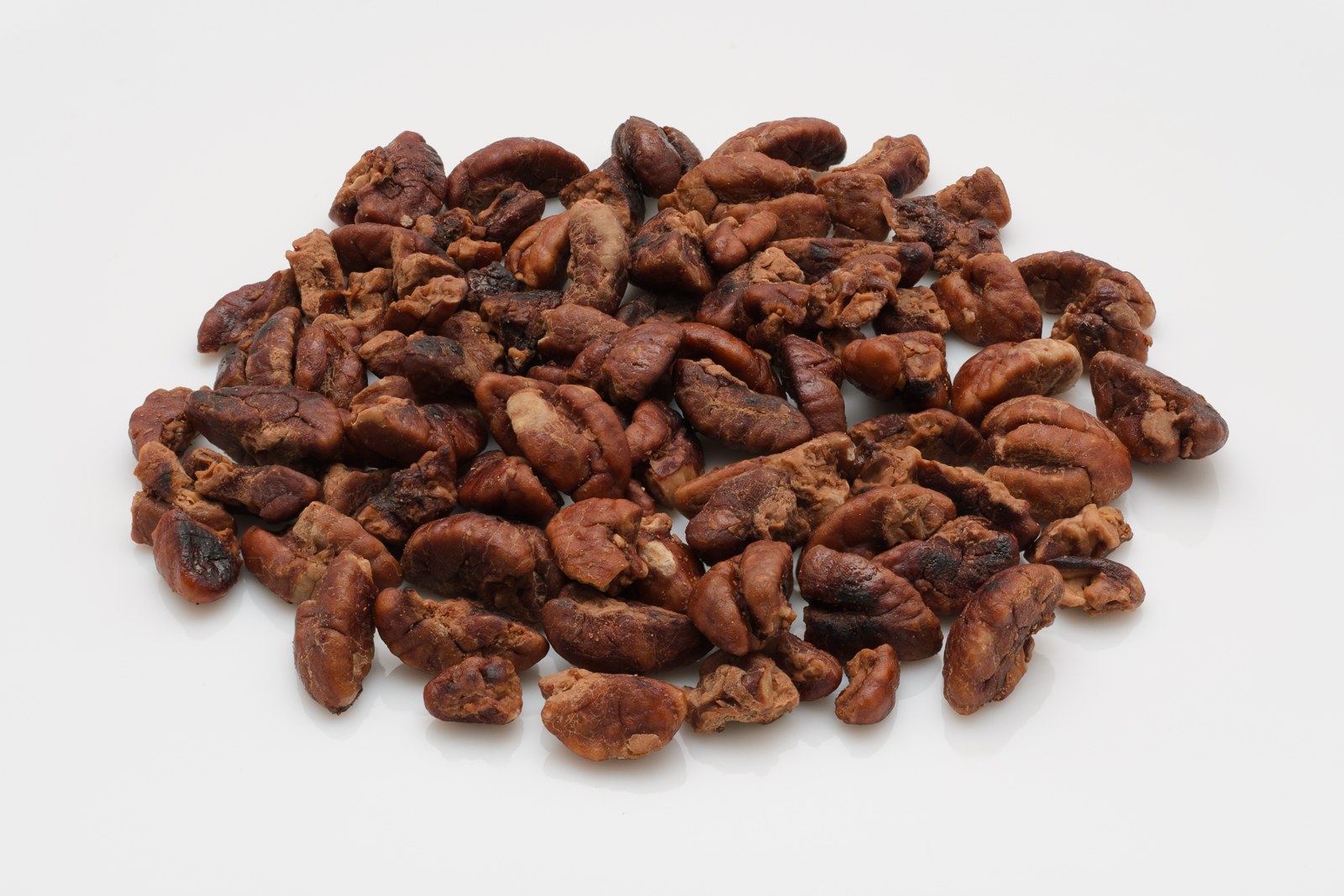
For nuts kept in their shells, the listed operations include grading, reducing astringency, seasoning, heating and packing. For kernels, the sequence includes boiling, shell removal, selection, astringency reduction, seasoning, stir-roasting, baking, finished-product selection and packaging. The document explicitly permits mechanical or manual kernel removal.
A cracked shell and a removed shell are therefore different processing outcomes. A hand-peelable product leaves the final opening to the eater; a kernel product has already passed through separation. The official description also calls for shell fragments and unsuitable kernels to be removed. The extra work is not simply making a shell easier to open: it is delivering a selected edible product.

Shell separation is a quality-control problem
Cracking a nut creates pieces of shell as well as access to the food. A 2022 Zhejiang University study explained why Chinese hickory is challenging: small shell fragments can resemble kernels in colour, complicating separation.
The researchers investigated hyperspectral imaging and a machine-learning model to distinguish the two. Their experimental results demonstrate a possible inspection technique, not that every processor has installed it or that a shop’s kernels have been checked by that system. The practical point is narrower: shell-fragment detection is a real production task, separate from breaking the shell in the first place.
Preparation takes time, but there is no single timetable
In a September 14, 2026 Tide News report, Hangzhou retailer Zou Feilong described his shop’s sequence: heating to open the shells, soaking in brine, drying overnight and then roasting. He put that sequence at roughly two days.
The same report quoted Fang Linfu’s shop charging 130 yuan per jin for its hand-peelable nuts and 160 yuan per jin for its traditional preparation. A jin here is 500 grams. Those were specific shop prices on that reporting date, not a market average, a current offer or a comparison with shelled kernels. Different preparations were being sold even within one shop.
What the processing chain tells us about price
A 2024 study in Sustainability, based in part on fieldwork at two Lin’an food companies, tracked inputs including energy, water, transport, labour and packaging. Its factory inventory included boiling, shelling, drying and sealing, along with bags, cartons and containers. These are useful categories for understanding production resources.
However, the study calculated carbon footprints, not retail costs. Its emissions figures cannot tell us what percentage of a packet’s price pays for labour, packaging or profit.
The defensible conclusion is that a finished nut carries work beyond harvesting: preparation, selection, shell handling and packing all matter. We cannot assign each stage a share of the selling price without that producer’s accounts and measured saleable output. Nor can we assume a fixed conversion from fresh fruit to kernels.
For buying decisions, compare the same product format and preparation. In-shell weight includes material you will discard; kernel weight does not. Check the packet’s ingredients, preparation and storage directions. For the next step at home, use our guide to opening and eating Chinese hickory nuts.